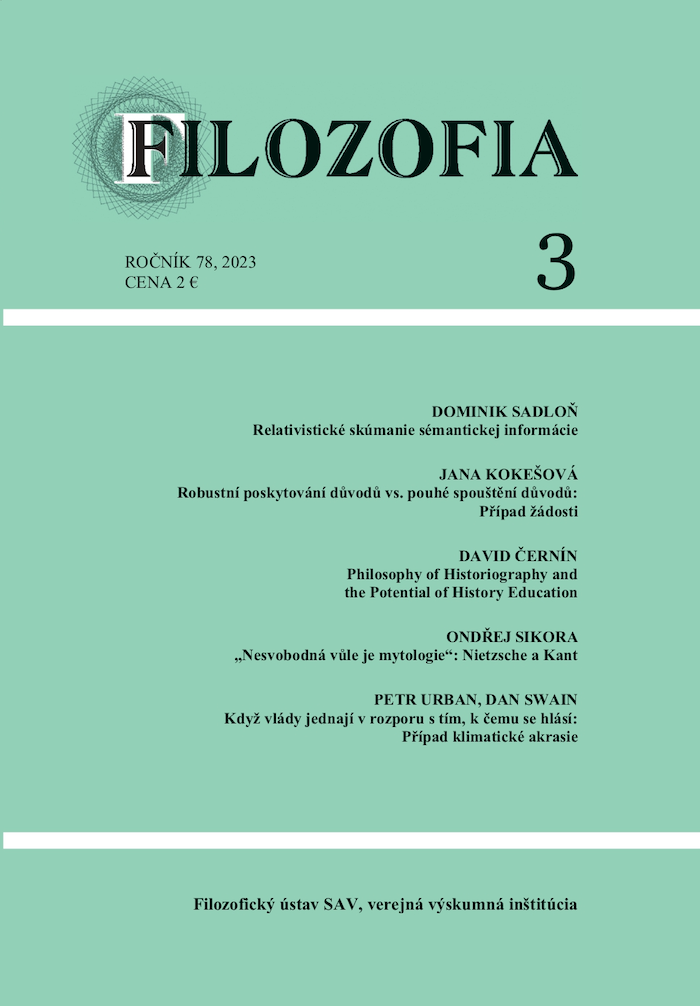
Author: Iwona Janicka
in On Revolt, Rebellion and Revolution. Navigating the Challenges of Human Conflict, ed. by Dominik Kulcsár, Dmytro Tomakh, and Jon Stewart, Leiden: Brill, 404–424 (2025)
DOI: doi.org/10.1163/9789004744721_019
Link to Zenodo
Abstract:
Climate change is challenging our key political concepts. In response to this challenge, recent political ecology has redefined the term “politics” by positing nonhumans (microbes, plants, ecosystems) as political actors because they radically impact our collective existence. As a result, our concept of politics has been shifting from a human-centered notion into a hybrid more-than-human one. This contribution considers how the ecological crisis is transforming the concept of “revolution” for the 21st century. By looking at selected thinkers in contemporary more-than-human political ecology, this chapter examines how we can conceptualize “revolution” and “revolutionary subject” if nonhumans are an integral part of politics. It analyzes the role of revolution in thinking about ecology and its usefulness for proposing more-than-human politics for the 21st century. Finally, this contribution proposes the concept of cosmological rebooting: it argues that we need to fundamentally rethink our ontological and existential concepts in order to be able to create more habitable worlds for humans and nonhumans alike.
•• More publications:
Author: Iwona Janicka
in On Revolt, Rebellion and Revolution. Navigating the Challenges of Human Conflict, ed. by Dominik Kulcsár, Dmytro Tomakh, and Jon Stewart, Leiden: Brill, 404–424 (2025)
DOI: doi.org/10.1163/9789004744721_019
Link to Zenodo
Abstract:
Climate change is challenging our key political concepts. In response to this challenge, recent political ecology has redefined the term “politics” by positing nonhumans (microbes, plants, ecosystems) as political actors because they radically impact our collective existence. As a result, our concept of politics has been shifting from a human-centered notion into a hybrid more-than-human one. This contribution considers how the ecological crisis is transforming the concept of “revolution” for the 21st century. By looking at selected thinkers in contemporary more-than-human political ecology, this chapter examines how we can conceptualize “revolution” and “revolutionary subject” if nonhumans are an integral part of politics. It analyzes the role of revolution in thinking about ecology and its usefulness for proposing more-than-human politics for the 21st century. Finally, this contribution proposes the concept of cosmological rebooting: it argues that we need to fundamentally rethink our ontological and existential concepts in order to be able to create more habitable worlds for humans and nonhumans alike.
•• More publications:
Celetná 988/38
Prague 1
Czech Republic
This project receives funding from the Horizon EU Framework Programme under Grant Agreement No. 101086898. Views and opinions expressed are however those of the author(s) only and do not necessarily reflect those of the European Union or European Innovation Council and European Research Executive Agency (REA). Neither the European Union nor the granting authority can be held responsible for them.
Celetná 988/38
Prague 1
Czech Republic
This project receives funding from the Horizon EU Framework Programme under Grant Agreement No. 101086898. Views and opinions expressed are however those of the author(s) only and do not necessarily reflect those of the European Union or European Innovation Council and European Research Executive Agency (REA). Neither the European Union nor the granting authority can be held responsible for them.